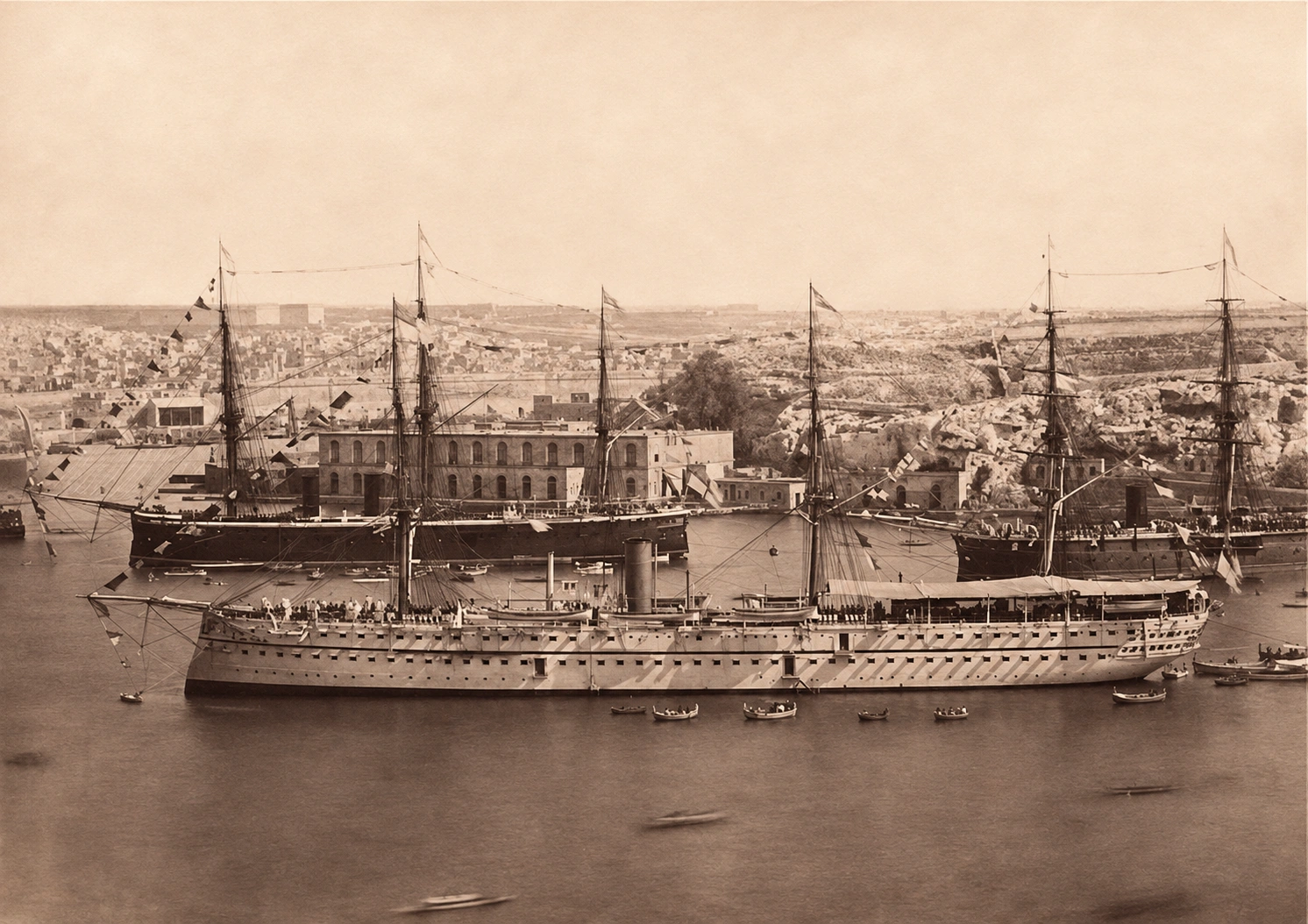
A large vessel identified in the archive caption as a British troopship lies among other ships and small boats in Grand Harbour. The ship’s name and the exact date have not yet been established.
A long, light-coloured hull stretches across the photograph, its masts and funnel rising in front of a crowded harbour background. Small boats gather around the larger vessel, while other ships and waterfront buildings occupy the space beyond it. The different scales of craft show how a major ship and local boat traffic shared the same harbour waters.
A naval and commercial harbour
In nineteenth-century Malta, Grand Harbour served both military and commercial purposes. It was a place where naval requirements, shipping and shore facilities overlapped. Research into the harbour’s extension during the 1850s to the 1870s places the development of its infrastructure within that combined economic and strategic setting.
The photograph is a useful visual record of that harbour world. Tall masts remain prominent even on a vessel with a funnel, while the low buildings and densely occupied shore provide a sense of the harbour’s working surroundings. The image alone does not reveal which vessel was arriving, departing or simply lying at anchor.
A ship still to be identified
The caption supplied with this photograph describes a British troopship and places the scene in the 1870s. Those details are retained as the archive’s identification rather than a confirmed match to a named vessel.
A reliable identification would need comparison with a ship’s documented hull, mast arrangement and fittings, ideally supported by a dated photograph or a harbour record. If you recognise the vessel, please share the evidence or the source of your information. Naming it would help connect this broad harbour scene to the people and journeys behind it.
Historical references
University of Malta — The Grand Harbour extension project: economic and political implications for British Malta, 1858–1870s.
Transport Malta — Port of Valletta. These sources provide historical context; they do not identify the pictured vessel.