✣Old MaltaIslands. Stories. Memories.
MaltaGozoCominoMalta in WW2Now and ThenHelp identifyAerial viewsVintage Maltese BusesPosters & Illustrations

circa 1924

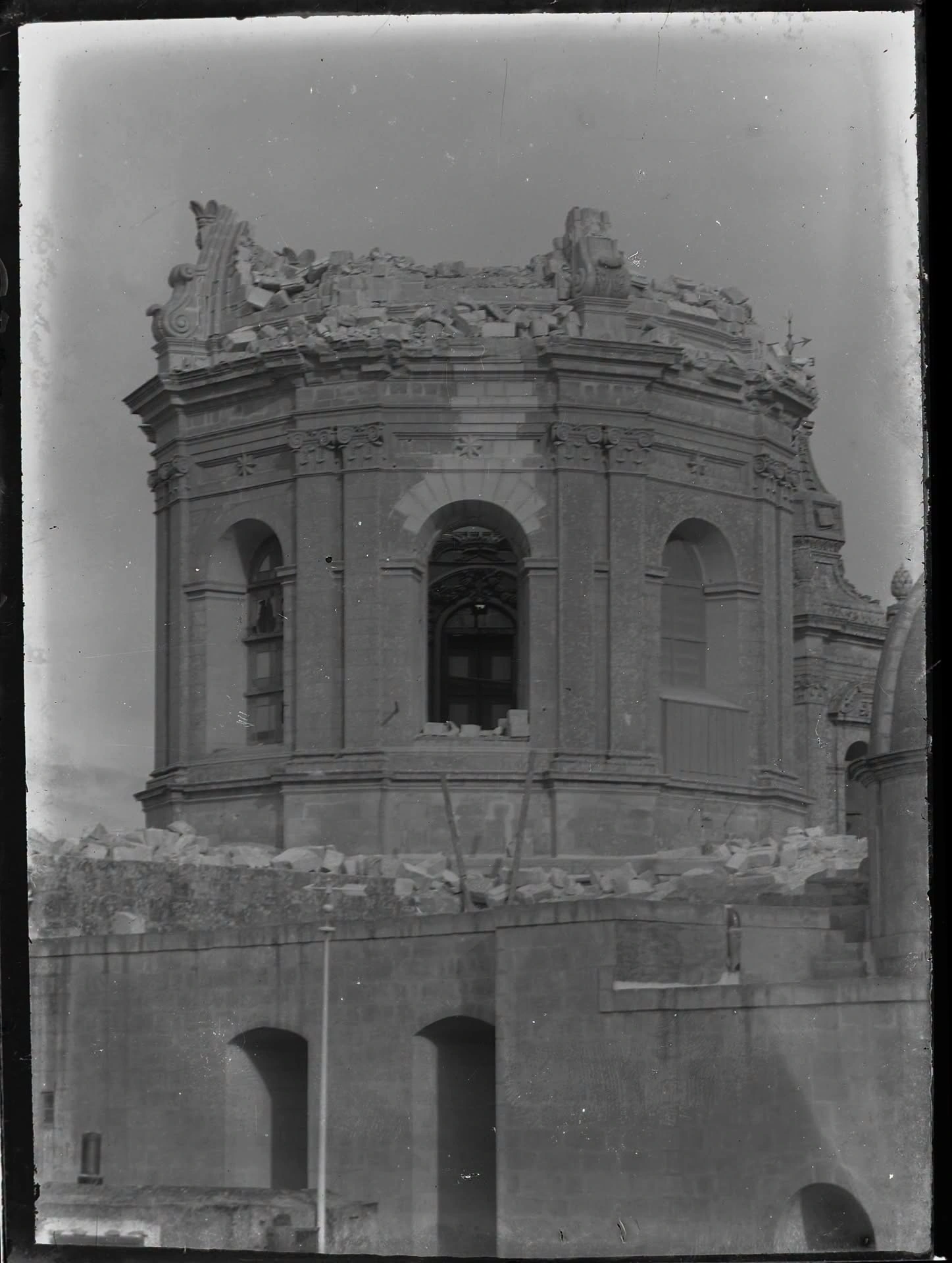
The Broken Dome of St Paul’s Church in Rabat after the 1924 Collapse

Swipe across the photograph or use your keyboard’s left and right arrow keys to browse.

Original photoWeb version optimised without generated detailsCopyright / report rights
Share this memoryFacebookPinterestXRedditWhatsApp

Rubble lies around the octagonal drum of St Paul’s Church in Rabat after its dome collapsed in 1924.

A drum open to the sky

The dome itself has disappeared, leaving broken masonry around the upper rim of the octagonal drum. Tall arched openings remain below, and large pieces of stone lie on the lower roof. Fragments of the former upper decoration still stand above the wall, emphasising the extent of the collapse.

Rabat’s 1924 collapse, identified correctly

The original post asks whether this was wartime damage. Two contributors instead identify St Paul’s Church in Rabat after its dome collapsed in November 1924. The archdiocesan Church Trails project confirms that collapse and the subsequent rebuilding directed by Robert Galea. The archive uses circa 1924 for the aftermath view and does not place it in the Second World War collection.

The people make the picture

Your memories belong here.

Share your story

A familiar face. The name of a street. A moment you remember. Help us tell the stories this photograph cannot tell on its own.

Be the first to share a memory

Everyone remembers something different

What does this photograph
bring back for you?

Did you live here? Do you recognise someone? Tell us about the shops, the neighbours, the everyday moments — or help identify the street or year.

You don’t need to know every detail. Say what you remember, and let us know when you are unsure.

There is room for everyone’s story. An editor reviews each contribution before publication. Your email, if supplied, stays private.
A few lines or a longer story — both are welcome. Use blank lines for paragraphs. Please share your own recollections and make clear which details are uncertain.
Can you identify the place, landmark, street or year? (optional)A recognised place or landmark is a suggestion until an editor checks it.For example: circa 1935, 1930–1940, or “I think this was the late 1950s”.

How we handle your contribution