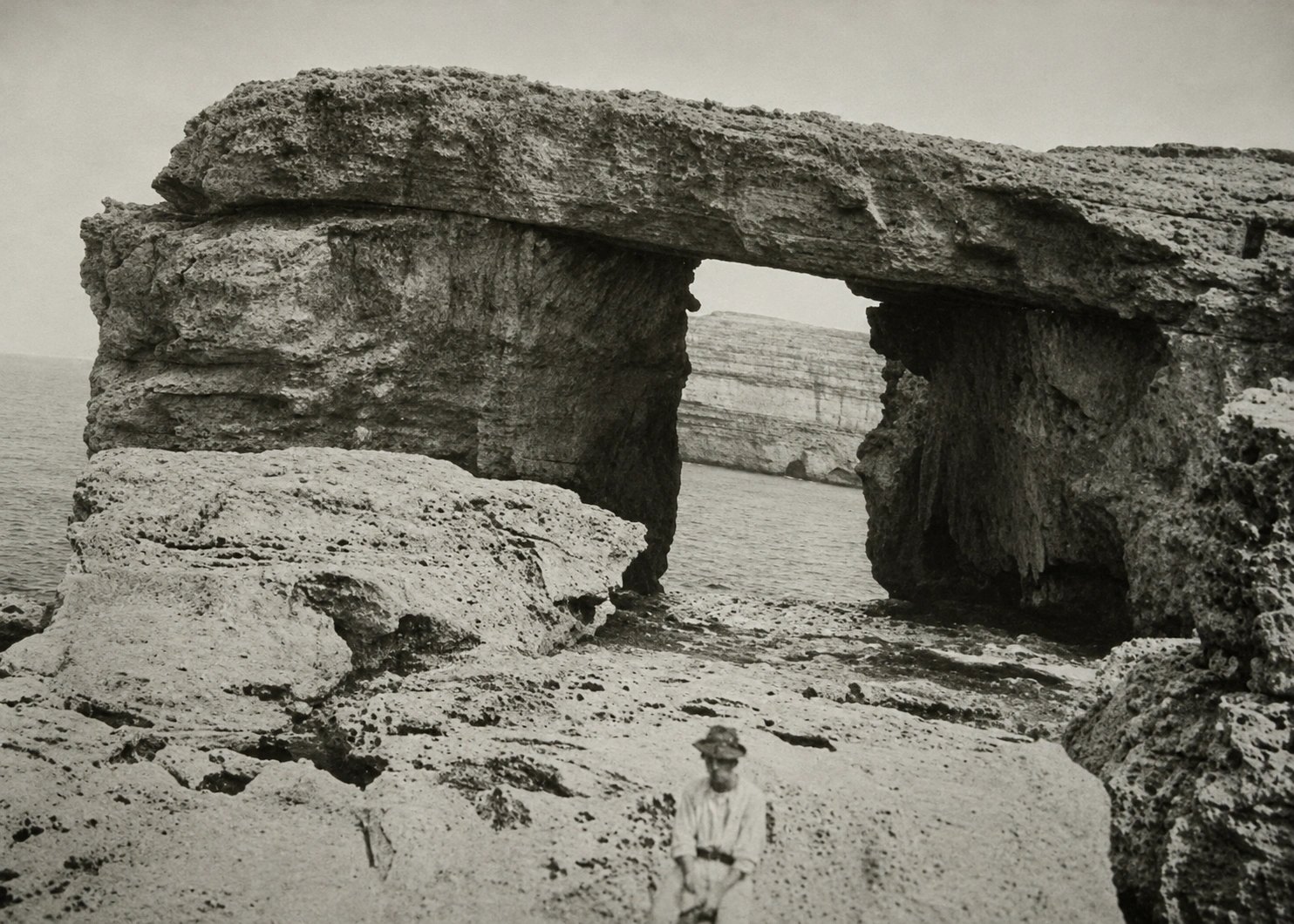
A person stands on the rocky shore in front of Gozo’s Azure Window, providing a sense of the natural arch’s scale. The photograph is dated around 1880 in the archive, but the person and exact date remain unidentified.
The small figure near the foreground gives this view a human scale. Behind the person, the Azure Window’s heavy stone span bridges a dark opening through which the water and the more distant coast can be seen. Broad, uneven rock surfaces occupy much of the picture, bringing the texture of the shore as much into view as the arch itself.
A person in the Dwejra landscape
The person’s identity is not recorded. The photograph does not tell us whether this was a local resident, a visitor or someone accompanying the photographer. Their presence is nevertheless useful when looking at the relationship between the foreground ledges, the supporting rock and the opening beyond.
Dwejra lies below San Lawrenz on Gozo’s western coast. Official local-history material places the former Azure Window within this wider landscape of inlets, coastal rock and other natural features. The photograph records one viewpoint within that setting rather than the whole area.
A view that can no longer be repeated
The Azure Window collapsed on 8 March 2017, after a long process of erosion. Historic photographs now preserve viewpoints in which the arch still linked the rocks above the water. This gives even an unidentified figure and an uncertain date a place in the visual record of a lost landmark.
The archive caption dates this image to around 1880. That dating remains provisional. If you recognise the photograph from a documented collection, know the person shown, or can identify an original caption, please share that information with its source.
Historical references
Gozo Album — Id-Dwejra, Government of Malta.
University of Malta repository — Creating value from the Azure Window (2021).