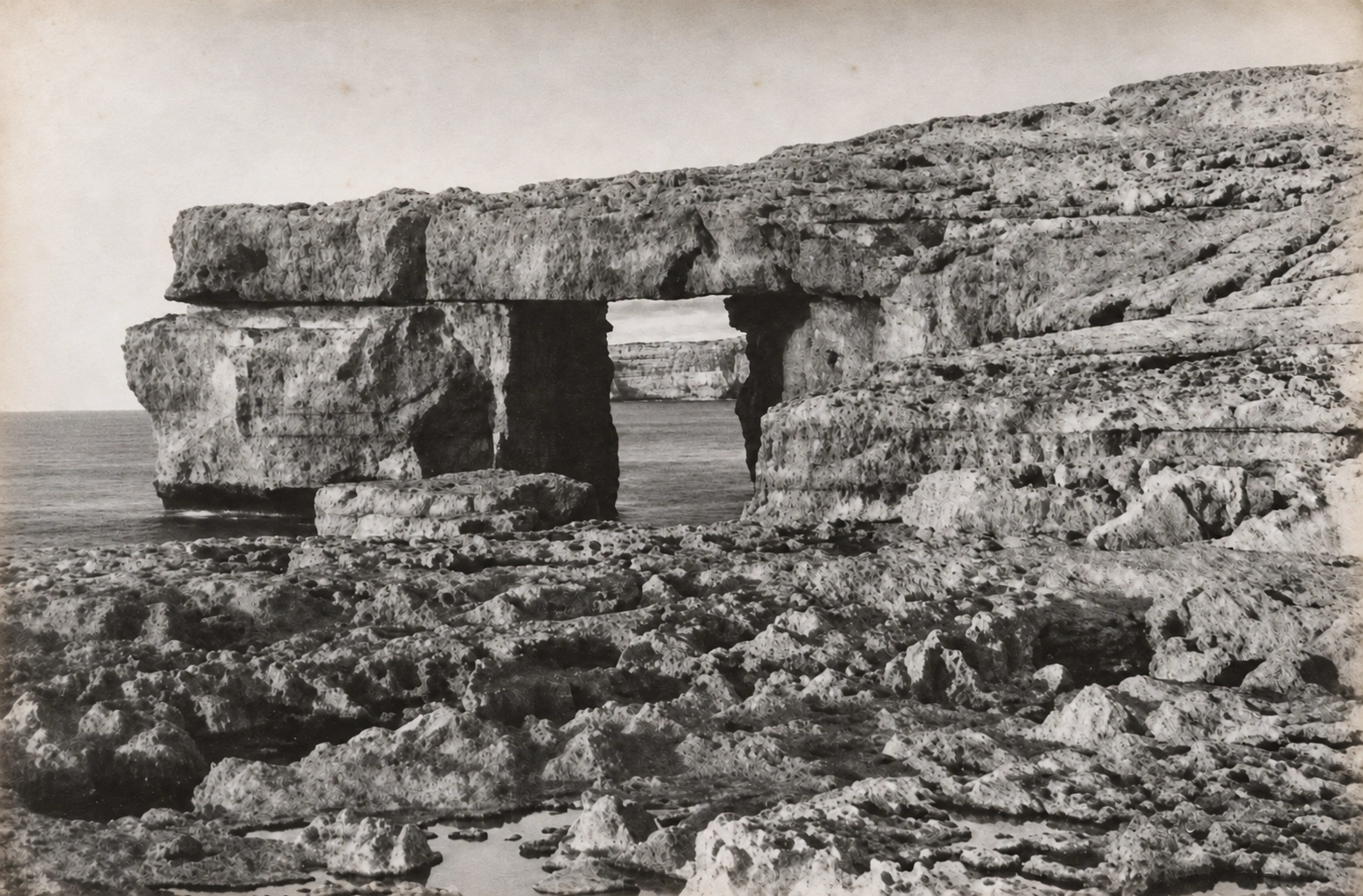
An early view of Gozo’s Azure Window, with the natural arch rising above a rough limestone shore at Dwejra. The archive places the image in the 1880s; the precise date remains unconfirmed.
The arch forms a dark opening between the sea and the rough limestone shore. Its broad upper section and the massive rock on either side give the scene its distinctive shape. In the foreground, uneven ledges and weathered surfaces make the shore look very different from a smooth promenade or a formal viewpoint.
A landscape shaped by the sea
The Azure Window stood at Dwejra on the western side of Gozo, near San Lawrenz. It became one of the island’s most widely recognised natural landmarks, but it belonged to a coastal landscape that was continually changing. Erosion was part of the same process that made the rock formation visually distinctive and gradually weakened it.
The arch collapsed on 8 March 2017. A notice issued by Transport Malta immediately afterwards warned that the collapse had changed the coastal and underwater topography. The remains became part of the underwater landscape rather than an arch above the water.
Looking back at a vanished landmark
This photograph preserves the Window as a complete structure. Comparing it with later images can help show changes in outline and viewpoint, although differences in camera position should not automatically be read as erosion.
The archive associates this image with the 1880s. That is the supplied dating of the photograph, not an independently verified exposure date. An identified photographer, a documented print or a collection catalogue would help strengthen its place in the photographic history of Dwejra.
Historical references
Visit Gozo — Dwejra.
Transport Malta — Notice to Mariners 14 of 2017, issued after the collapse.
University of Malta repository — Creating value from the Azure Window (2021).