✣Old MaltaIslands. Stories. Memories.
MaltaGozoCominoMalta in WW2Now and ThenHelp identifyAerial viewsVintage Maltese BusesPosters & Illustrations

circa 1938

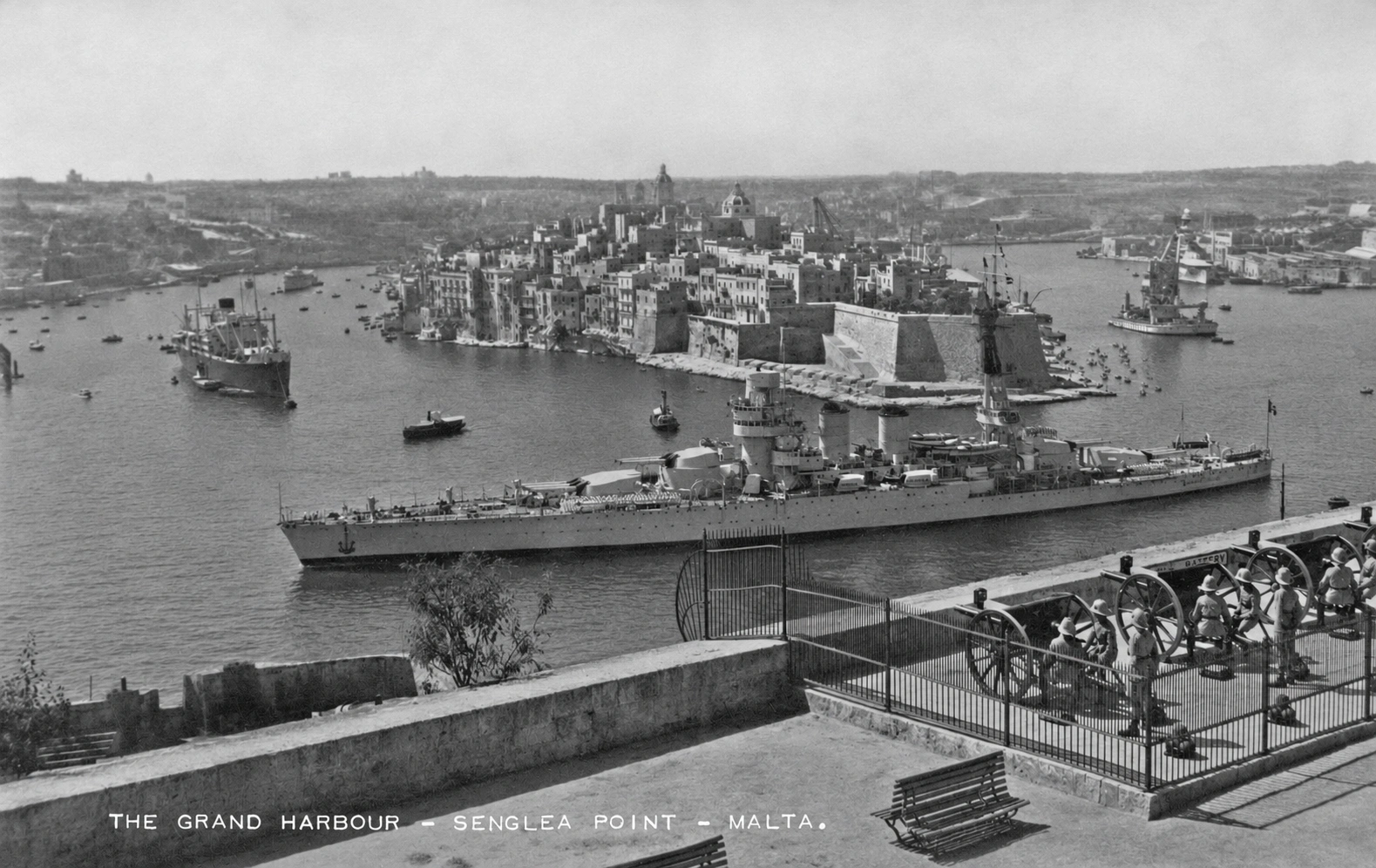
Conte di Cavour below the Saluting Battery

Swipe across the photograph or use your keyboard’s left and right arrow keys to browse.

Share this memoryFacebookPinterestXRedditWhatsApp

The Italian battleship Conte di Cavour passes below the Saluting Battery, with Senglea’s waterfront and fortifications across Grand Harbour.

Cannons above the harbour

The Saluting Battery’s guns and railings fill the foreground, while a large battleship crosses the water below. Senglea’s closely built waterfront, church domes and bastions form the opposite shore. Other ships and small boats are spread across the harbour, giving the photograph a broad record of its naval and urban setting.

A visit before the war

The source caption identifies Conte di Cavour during a visit between 21 and 24 June 1938. The archive displays circa 1938 and retains the original postcard caption naming Grand Harbour and Senglea Point. The supplied reproduction carries an Archivio S. Cioglia collection mark, which is recorded in the credit. A reviewed restoration repairs scan marks and removes the later overlay; the unchanged source remains available through the Original photo link.

The people make the picture

Your memories belong here.

Share your story

A familiar face. The name of a street. A moment you remember. Help us tell the stories this photograph cannot tell on its own.

Be the first to share a memory

Everyone remembers something different

What does this photograph
bring back for you?

Did you live here? Do you recognise someone? Tell us about the shops, the neighbours, the everyday moments — or help identify the street or year.

You don’t need to know every detail. Say what you remember, and let us know when you are unsure.

There is room for everyone’s story. An editor reviews each contribution before publication. Your email, if supplied, stays private.
A few lines or a longer story — both are welcome. Use blank lines for paragraphs. Please share your own recollections and make clear which details are uncertain.
Can you identify the place, landmark, street or year? (optional)A recognised place or landmark is a suggestion until an editor checks it.For example: circa 1935, 1930–1940, or “I think this was the late 1950s”.

How we handle your contribution