✣Old MaltaIslands. Stories. Memories.
MaltaGozoCominoMalta in WW2Help identifyAerial viewsVintage Maltese BusesPosters & Illustrations

Date not confirmed

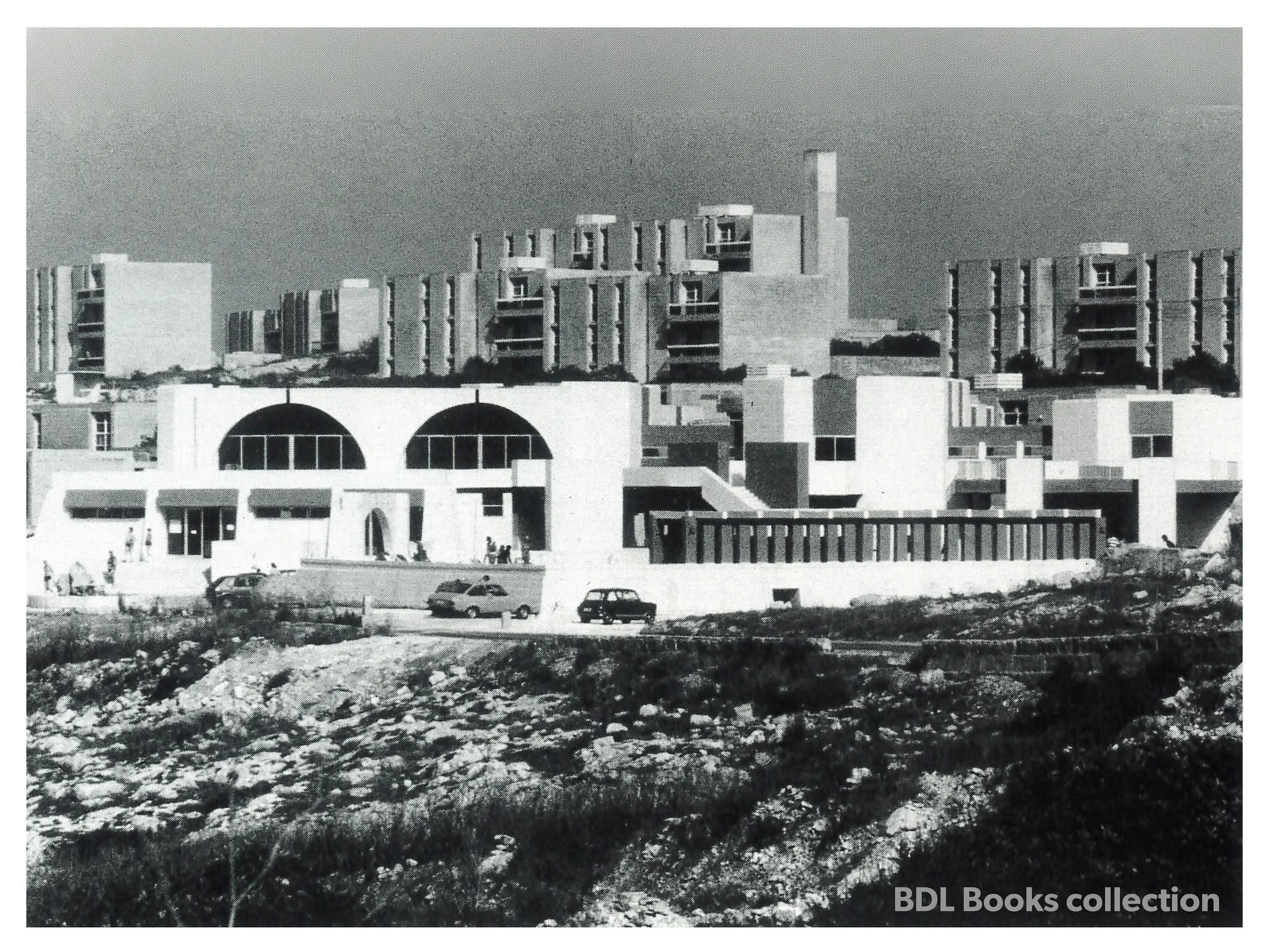
White Rocks Holiday Buildings below the Former Military Quarters

Photo 36 of 608 in the archive · Back to the archive

Swipe across the photograph or use your keyboard’s left and right arrow keys to browse.

Low White Rocks holiday buildings with large semicircular windows stand below the taller former military quarters, with cars and rough coastal ground in front.

Pembroke · Date not confirmed

Arches below the accommodation blocks

The low white building in the foreground is shaped by broad semicircular windows, flat roofs and a long open screen. Cars stand on the road below, separated from the camera by rocky ground and low scrub. Behind it, taller accommodation blocks repeat a pattern of balconies and narrow vertical elements. The photograph records the relationship between the holiday facilities and the earlier residential buildings.

Two stages of the White Rocks site

BDL Books identifies the foreground as part of Richard England’s holiday-complex design and the buildings behind as the former St Patrick’s Officers’ Married Quarters. The professional architectural account published by Kamra tal-Periti documents the earlier military buildings as a separate design by Austin-Smith Salmon Lord Partnership. These are distinct stages in the site’s development. The individual exposure year is unconfirmed, and the visible BDL Books collection credit is retained.

Original photoWeb version optimised without generated detailsCopyright / report rights
Share
Share this memoryFacebookPinterestXRedditWhatsApp

The people make the picture

Your memories belong here.

Share your story

A familiar face. The name of a street. A moment you remember. Help us tell the stories this photograph cannot tell on its own.

Be the first to share a memory

Everyone remembers something different

What does this photograph
bring back for you?

Did you live here? Do you recognise someone? Tell us about the shops, the neighbours, the everyday moments — or help identify the street or year.

You don’t need to know every detail. Say what you remember, and let us know when you are unsure.

There is room for everyone’s story. An editor reviews each contribution before publication. Your email, if supplied, stays private.
A few lines or a longer story — both are welcome. Use blank lines for paragraphs. Please share your own recollections and make clear which details are uncertain.
Can you identify the place, landmark, street or year? (optional)A recognised place or landmark is a suggestion until an editor checks it.For example: circa 1935, 1930–1940, or “I think this was the late 1950s”.

How we handle your contribution